Themelios

Themelios Vol 36.3

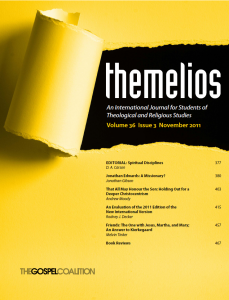
Themelios36.3-229x300.pngDie neue Ausgabe der Zeitschrift Themelios ist vor einigen Tagen erschienen. Dabei ist diesmal u.a. ein Artikel von Jonathan Gibson über Jonathan Edwards. Er schreibt in: „Jonathan Edwards: A Missionary?“:

Jonathan Edwards (1703–1758) is remembered today as a saint, scholar, preacher, pastor, metaphysician, revival leader, theologian, Calvinist—the list goes on. However, ‚If there is one area of Edwards’s life that has been consistently overlooked and understated by contemporaries and scholars alike, it is his role as Indian missionary and advocate for Indian affairs.‘ It is indeed hard to imagine: a white British colonial Puritan, with powdered wig and Geneva bands, as a missionary to native American Indians. Of course, historically, the issue is not debated. In August 1751, following a three-month trial period in the spring of the same year, Jonathan Edwards moved to the frontier mission outpost of Stockbridge where he served for nearly seven years, just prior to his death in March 1758. His role at Stockbridge was two-fold: to pastor the English congregation and to serve as missionary to the Indians.

Hier geht’s zum Journal, das auch als PDF-Datei heruntergeladen werden kann: thegospelcoalition.org.

Themelios 36.1

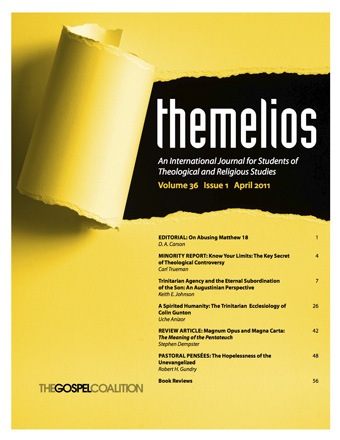
Themelios36.1.jpgDie neue Ausgabe der Zeitschrift Themelios ist erschienen. Neben zahlreichen Rezensionen enthält Themelios 36.1 folgende Beiträge:

  • D. A. Carson: On Abusing Matthew 18
  • Carl Trueman: Know your Limits: The Key Secret of Theological Controversy
  • Keith E. Johnson: Trinitarian Agency and the Eternal Subordination of the Son: An Augustinian Perspective
  • Uche Anizor: A Spirited Humanity: The Trinitarian Ecclesiology of Colin Gunton
  • Stephen Dempster: Magnum Opus and Magna Carta: The Meaning of the Pentateuch
  • Robert H. Gundry: The Hopelessness of the 48 Unevangelized

Hier die Zeitschrift als PDF-Datei: Themelios36.1.pdf.

Themelios 35.3 online

Themelios35.3.jpgDie Ausgabe 35.3 des theologischen Journals Themelios ist online abrufbar.

  • D.A. Carson: Editorial: Contrarian Reflections on Individualism
  • Carl Trueman: Minority Report: Terrible Beauty, Beauty, and the Plain Terrible
  • Daniel J. Estes: Fiction and Truth in the Old Testament Wisdom Literature
  • Daniel J. Brendsel: Plots, Themes, and Responsibilities: The Search for a Center of Biblical Theology Reexamined
  • Stephen M. Garrett: The Dazzling Darkness of God’s Triune Love: Introducing Evangelicals to the Theology of Hans Urs von Balthasar
  • Philip Graham Ryken: Pastoral Pensées A World Servant in Christian Liberal Arts Education
  • Über 60 Buchbesprechungen

Hier das PDF: themelios-35-3.pdf.

Themelios 35.2

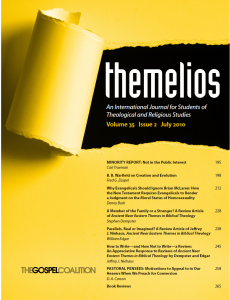
Themelios35.2-230x300.pngDie neue Ausgabe der Zeitschrift Themelios ist erschienen. Zum Inhalt gehören:

  • Carl Trueman: MINORITY REPORT: Not in the Public Interest
  • Fred G. Zaspel: B. B. Warfield on Creation and Evolution
  • Denny Burk: Why Evangelicals Should Ignore Brian McLaren: How the New Testament Requires Evangelicals to Render a Judgment on the Moral Status of Homosexuality
  • Stephen Dempster: A Member of the Family or a Stranger? A Review Article of Ancient Near Eastern Themes in Biblical Theology
  • William Edgar: Parallels, Real or Imagined? A Review Article of Jeffrey J. Niehaus, Ancient Near Eastern Themes in Biblical Theology
  • Jeffrey J. Niehaus: How to Write—and How Not to Write—a Review: An Appreciative Response to Reviews of Ancient Near Eastern Themes in Biblical Theology by Dempster and Edgar
  • D. A. Carson PASTORAL PENSÉES: Motivations to Appeal to in Our Hearers When We Preach for Conversion
  • Book Reviews

Die aktuelle Ausgabe von Themelios kann gratis hier heruntergeladen werden: themelios-35-2.pdf.

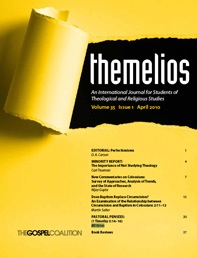
Themelios Vol. 35.1

themelios-35-1.jpgDie neue Ausgabe der Online-Zeitschrift Themelios ist da.

  • Editorial: Perfectionisms by D. A. Carson
  • Minority Report: The Importance of Not Studying Theology by Carl Trueman
  • New Commentaries on Colossians: Survey of Approaches, Analysis of Trends, and the State of Research by Nijay Gupta
  • Does Baptism Replace Circumcision? An Examination of the Relationship Between Circumcision and Baptism in Colossians 2:11–12 by Martin Salter
  • Pastoral Pensées: (1 Timothy 3:14–16) by Bill Kynes
  • Book reviews

Carl Trueman scheibt in seinem provozierenden Beitrag:

It might seem odd to write an editorial for a theological journal on the topic of not doing theology and how important that can be; and, indeed, perhaps it is contrarian even by my own exacting standards. But it is nonetheless important. Let me explain.

The greatest temptation of a theology student is to assume that what they are studying is the most important thing in the world. Now, i need to be uncharacteristically nuanced at this point: there is a sense, a very deep and true sense, in which theology is the most important thing in the world. it is, after all, reflection upon what God has chosen to reveal to his creatures; and it thus involves the very meaning of existence. in this sense, there is nothing more important than doing theology. But this is not the whole story. one of the great problems with the study of theology is how quickly it can become the study of theology, rather than the study of theology, that becomes the point. we are all no doubt familiar with the secular mindset which repudiates any notion of certainty in thought; and one of the reasons for this, i suspect, is that intellectual inquiry is rather like trying to get a date with the attractive girl across the road with whom you have secretly fallen in love: the thrill comes more from the chase and the sense of anticipation than it does from actually finding the answer or eliciting agreement to go to the movies. This plays out in theology in two ways. First and most obvious, there is a basic question of motivation which needs to be addressed right at the start of theological endeavour: am i doing this purely and simply for personal satisfaction? Has the study of theology become so central to my identity that the whole of my being is focused on it and seeks to derive things from it in a way which is simply unhealthy and distorts both its purpose and the person who i am? That is something with which all theologians will, i suspect, wrestle until the day they die, being part and parcel of who we are as fallen creatures; but there are also things we can do which ease the situation …

The second way in which the study of theology for study’s sake can play out is the manner in which it can ultimately disconnect you from reality, an odd result of studying that should, in theory at least, ground you more firmly in reality than anything else. i often wonder, as i sit in church on a sunday, of how much of the knowledge i have is truly significant for the people in the pews—the man who has just lost his job, the single mum struggling to hold it together, the teenager coping with all of the pressures that come with the transition to adulthood.

Hier die Internetseite mit der Möglichkeit, die Ausgabe herunter zu laden: www.thegospelcoalition.org.

Themelios 34.3

themelios-34-3.jpgAuch die neue Ausgabe von Themelios kann ich wieder empfehlen, allein wegen der Buchvorstellungen. Wayne Grudem kommt in seinem Beitrag über die Klarheit der Schrift zu folgenden Ergebnissen:
The clarity (or perspicuity) of Scripture is no minor doctrine.

  1. It provides the basis for giving us the Bible in our own language.
  2. It provides the basis for thinking we can read the Bible and understand it.
  3. It provides the basis for thinking that we even have a gospel-message to proclaim.
  4. It provides the basis for thinking that we can know what God wants us to believe, and how he wants us to live.
  5. It provides the basis for thinking that detailed study of Scripture, and even extensive academic study of Scripture, has great value, because it will eventually yield even fuller understanding of a Bible that is an infinite storehouse of wisdom and knowledge.
  6. It assures us that our infinite Creator, whom we seek to know and to worship, has loved us enough to speak to us in words that we can understand—and understand not only with our minds but with our hearts. Through these words of God, we know and follow him. And thus we experience in our lives what Jesus tells us will happen: »My sheep hear my voice, and I know them, and they follow me« (John 10:27).

Hier die Themelios-Ausgabe als kostenfreie PDF-Datei: tgc-documents.s3.amazonaws.com.pdf.

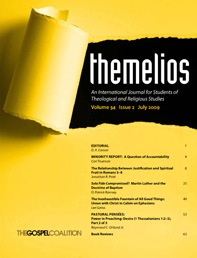
Themelios Vol. 34.2 ist da

themelios-34-2.jpgEine neue Ausgabe von Themelios steht im Internet zur Einsicht bereit. Ausgabe 34/2 enthält folgende Artikel:
  1. Editorial: D.A. Carson
  2. Minority Report: A Question of Accountability: Carl Trueman
  3. The Relationship Between Justification and Spiritual Fruit in Romans 5–8: Jonathan R. Pratt
  4. Sola Fide Compromised? Martin Luther and the Doctrine of Baptism: D. Patrick Ramsey
  5. The Inexhaustible Fountain of All Good Things: Union with Christ in Calvin on Ephesians: Lee Gatiss
  6. Pastoral Pensées: Power in Preaching: Desire (1 Thessalonians 1:2–5), Part 2 of 3: Raymond C. Ortlund Jr.
  7. Book Reviews

Hier kann die PDF-Datei kostenlos herunter geladen werden: Themelios_34.2.pdf.

Themelios 34.1

Themelios_34.1.jpgIn der Ausgabe von Themelios 33.3 schreibt Don Carson im Editorial:

The apostle Paul writes, »Do not conform to the pattern of this world, but be transformed by the renewing of your mind« (Rom 12:2). Elsewhere he tells the Corinthians, »We demolish arguments and every pretension that sets itself up against the knowledge of God, and we take captive every thought to make it obedient to Christ« (2 Cor 10:5).

Thinking differently from the »world« has been part of the Christian’s responsibility and agenda from the beginning. The language Paul uses intimates that this independence of thought will not be easy. The assumption seems to be that the world has its own patterns, its own structured arguments, its own value systems. Because we Christians live in the world, the »default« reality is that we are likely to be shaped by these patterns, structures, and values, unless we consciously discern how and where they stand over against the gospel and all its entailments, and adopt radically different thinking. More: our response must not only be defensive (Rom 12:2), but offensive, aiming to »demolish arguments and every pretension that sets itself up against the knowledge of God,« aiming to »take captive every thought to make it obedient to Christ« (2 Cor 10:5).

Neither Scripture nor experience suggests that this will be an easy task …

Die PDF-Datei der neuesten Ausgabe von Themelios (34.1) gibt es übrigens hier: s3.amazonaws.com.

Themelios 33.3

themelios-33-3.jpgDie neue Ausgabe des theologischen Journals Themelios ist verfügbar. Sie kann wieder frei eingesehen und herunter geladen werden.

Enthalten ist diesmal auch ein Aufsatz von Tim Keller zum Thema »The Gospel and the Poor«.

Hier geht es zum Herausgeber: www.thegospelcoalition.org.

Das Journal »Themelios« ist wieder da!

Themelios_33.1.jpgDas Journal Themelios wurde von der UCCF in Großbritannien an die The Gospel Coalition überführt. In Zukunft wird die beliebte theologische Zeitschrift nur noch in einer digitalen Version erscheinen. Als verantwortlicher Redakteur konnte der Neutestamentler D.A. Carson gewonnen werden.

Die Ausgabe 33.1 liegt inzwischen vor und kann als ePaper oder PDF-Datei (5,8 MByte) herunter geladen werden: www.thegospelcoalition.org.

Diese aktuelle Ausgabe von Themelios enthält neben zahlreichen Buchbesprechungen unter anderem folgende Beiträge:

  • Carl Trueman: »Minority Report: Why Should Thoughtful Evangelicals Read the Medieval Mystics?«, S. 2–4;
  • Paul Hartog: »Blondel Remembered: His Philosophical Analysis of the ›Quest for the Historical Jesus‹, S. 5–15;
  • Kirk R. MacGregor: »Nonviolence in the Ancient Church and Christian Obedience«, S. 16–28;
  • Dane C. Ortlund: »Truthfulness in Usefulness: Stanley Fish and American Literary Pragmatism«, S. 29–38;
  • Peter Sanlon: »An Augustinian Mindset«, S. 39–45;
  • Keith Ferdinando: »Mission: A Problem of Definition«, S. 46–59.

Nebenbemerkung: Besonders gefällt mir der Artikel von Peter Sanlon über Augustins‘ De doctrina Christiana (»An Augustinian Mindset«). Das Werk des Kirchenvaters wird unterschätzt, obwohl es unter Experten eine hohe Aufmerksamkeitsbindung erziehlt hat. Ich kann die Lektüre sehr empfehlen. Eine hervorragende deutsche Übersetzung hat die Altphilologin Karla Pollmann besorgt (Augustinus, Die christliche Bildung, Stuttgart: Reclam, 2002, leider vergriffen). Ich habe vor vielen Jahren ein Bibelstellenregister zum Buch erarbeitet, dass hier herunter geladen werden kann: www.bucer.eu.

Robert Bradshaw hat freundlicherweise viele ältere Artikel des Journals digitalisiert: www.biblicalstudies.org.uk. Es ist erfreulich, dass Themelios weiterexistiert und Studenten und Theologen mit einer guten »Grundlage« versorgt!

Nach oben scrollen
DSGVO Cookie Consent mit Real Cookie Banner