Neues Testament

Paulus und die Hölle

In den meisten Bibelübersetzungen fehlt das Wort »Hölle« in den paulinischen Briefen. Der Apostel hat die griechischen Begriffe »geena« oder »hadēs« in seinen neutestamentlichen Schreiben nicht benutzt. Sagt Paulus dennoch etwas über ein ewiges Strafgericht für diejenigen, die Gottes befreiendes Evangelium ablehnen? Und wenn ja, wie stellt er sich so eine Strafe vor?

Der Neutestamentler Douglas J. Moo (Wheaton College, USA) geht in seinem Beitrag »Paul on Hell« für das Buch Hell Under Fire: Modern Scholarship Reinvents Eternal Punishment genau diesen Fragen nach.

Der Aufsatz kann gratis hier heruntergeladen werden: paulonhell.pdf.

Zweierlei Diaspora

31rmBvqnF8L._SL160_.jpgUnd wieder eine neue Perspektive:

Ein schmales Büchlein mit einer These, die unser Bild des antiken Judentums grundlegend verändert. Denn innerhalb der jüdischen Geschichtsschreibung hatte man bisher weithin angenommen, dass sich in der Antike das religiöse und kulturelle Leben im östlichen wie im westlichen Judentum unter dem Einfluss der Rabbinen des Landes Israel, der Tannaim (1. und 2. Jahrhundert nach Christus) und der Amoraim (etwa 220 bis 360/70), entwickelt habe.

Demgegenüber behaupten der Althistoriker Doron Mendels von der Hebräischen Universität in Jerusalem und der in Tel Aviv lehrende Rechtshistoriker Arye Edrei jetzt, die jüdische Diaspora, also die Welt der Juden, die außerhalb Palästinas lebten, sei in dieser Zeit zweigeteilt gewesen: Es habe zwei Sprachen, Griechisch (und in geringerem Maße auch Lateinisch) im Westen und Hebräisch/Aramäisch im Osten, gegeben und, damit eng verknüpft, auch zwei »Wissenskulturen«, ja »zweierlei Judentum«.

Ich gestehe, ich habe das Buch bisher nicht gelesen (und bin zurückhaltend). Allerdings vermute ich, dass sich die These, das europäische Judentum sei in der ausgehenden Antike eine bunte Ansammlung von Gruppen mit unterschiedlicher Homogenitäts- und Organisationsdichte gewesen, recht gut belegen lässt.

Hier die Rezension von Wolfram Kinzig: www.faz.net. Das Buch:

  • Doron Mendels und Arye Edrei: »Zweierlei Diaspora«: Zur Spaltung der antiken jüdischen Welt, Vandenhoeck & Ruprecht, Göttingen 2010. 159 S., 24,90 Euro

gibt es auch:

Interview mit Andreas Kostenberger

51pZEBljdrL._SL160_.jpgKevin de Young hat mit dem hervorragenden Exegeten Andreas Kostenberger über sein Buch The Missions of Jesus and the Disciples According to the Fourth Gospel gesprochen.

Kevin: In a couple sentences, what is the mission of Jesus in the gospel of John? Is the mission of the disciples the same as Jesus’ mission?

Kostenberger: Essentially, there are three facets to Jesus’ mission in John’s Gospel: he is (1) the sent Son; (2) the one came into the world and returned to the place from where he came (descent-ascent); and (3) the eschatological Shepherd-teacher. The mission of the disciples is similar to Jesus’ only with regard to his sending, that is, they are to emulate the obedient and faithful relationship Jesus sustained with the Father in their relationship with the exalted Jesus as they go about their mission.

Hier mehr: thegospelcoalition.org.

Neue Dissertation über »Jesus und die Ehebrecherin«

John David Punch hat unter der Supervision von an G. van der Watt eine Dissertation über die Perikope von der Ehebrecherin (Joh 7,53–8,11) geschrieben. Punch schlägt keine neue Lösung des textkritischen Problems vor (Nestle-Aland stuft den Abschnitt als nicht ursprünglich ein; siehe auch hier), gewährt aber durch seine Arbeit einen Einblick in die aktuelle Diskussion.

Hier das Abstract:

A new dissertation in New Testament textual criticism has seen the light at Radboud Universiteit Nijmegen written by John David Punch under the supervision of Jan G. van der Watt, and with the title „The Pericope Adulterae: Theories of Insertion and Omission.“

While the majority of the scholarly world seems to be settled in accepting the fact that the Pericope Adulterae (John 7:53-8:11) is a non- Johannine interpolation, numerous questions remain unanswered in regards to the pericope, such as who penned these words, where the story originates from, and when was it inserted/omitted/re-inserted into the Fourth Gospel. In addition to this, there are mild debates that continue in regards to Greek manuscripts, the influence of lectionary practice, and the relevancy of the Patristic witnesses. Further, there is a minority who still argue for the inclusion of the Pericope Adulterae in the Fourth Gospel. Though there is a majority viewpoint, issues related to John 7:53-8:11 appear to be far from settled.

The present work does not argue for either side, but instead tests a hypothesis of several theories relating to the insertion or omission (and subsequent re-insertion) of the passage from the Gospel of John. Such theories are proposed in relation to collation of internal and external evidence both for and against the inclusion of the pericope. No particular theory is advocated for; instead each theory is evaluated based upon the evidence presented in this work and suggestions for further work are offered.

Chapter 1 presents an introduction to the Pericope Adulterae itself, along with a brief summary of the history of biblical interpretation and the history of such interpretation in relation to the Gospel of John in particular. Five theories of omission/insertion are then highlighted, setting the foundation for the work that will follow. These theories are categorized as Redactional Insertion, Ecclesiastical Insertion, Liturgical Omission, Accidental Omission, and Ecclesiastical Suppression.

Chapter 2 summarizes the history of research regarding John 7:53-8:11, beginning with the nineteenth century developments in textual criticism that broke away from Textus Receptus. This summary is not exhaustive, but rather highlights the major movements in the research of this passage up to the present day, detailing scholars who have either had a profound impact on textual criticism, written major works relating to the Pericope Adulterae, or written multiple works on the subject.

Chapter 3 presents a working translation and exegesis of the pericope. The translation is offered with comparison to the numerous variants associated with the passage; the exegesis is offered based upon the traditional location of John 7:53-8:11 immediately following John 7:52 and preceding 8:12.

Chapters 4 and 5 discuss the internal evidence of the literary context, style, and vocabulary of the Pericope Adulterae. In Chapter 4, comparison is made between the pericope and the immediate context of John 7-8 as well as the larger context of the Gospel of John. This includes discussion of various themes common to the Tabernacles Discourse and to the Gospel of John as a whole. Further, issues of transition between John 7:52 and 8:12 are evaluated. In Chapter 5, suggested “non-Johannine“ and “Johannine“ style and vocabulary are discussed, in addition to arguments relating to hapax legomena, Lukan and/or Synoptic influence, and the relationship between the Pericope Adulterae and Susanna.

Chapter 6 presents the external evidence of the Greek papyri/ manuscripts, manuscripts in additional languages, and the Patristic Witnesses. Evaluation is made in regards to both the presence and absence of John 7:53-8:11 in numerous manuscripts and in the works of various Church Fathers. Further, several theories traditionally offered in response to the external evidence, such as Source Theories, Lectionary Text Theories, Majority Text Theories, and Multiple Edition Theories, are discussed as well.

Chapter 7 discusses each of the theories presented in Chapter 1. The five theories presented include Redactional Insertion, suggesting that a later Johannine redactor or community inserted the pericope at a later date; Ecclesiastical Interpolation, suggesting that later scribes not related to the Johannine redactor or community inserted the pericope; Liturgical Omission, suggesting that due to lectionary practice and manuscripts the pericope was omitted; Accidental Omission, suggesting that multiple copies of the Gospel of John were released, one without the pericope and one with the pericope; and Ecclesiastical Suppression, suggesting that the Church omitted the pericope out of fears that it could be misinterpreted and/or misapplied. Each theory is treated individually, though at times theories overlap with one another. Further, each is evaluated based upon the evidence presented in Chapters 4-6. Following this evaluation, suggestions for further study of the Pericope Adulterae are offered.

Die Arbeit kann hier herunter geladen werden: FORMATTED.%20JD%20PUNCH%20FINAL%203.4.10a.pdf.

VD: evangelicaltextualcriticism.blogspot.com

Ein theologischer Dialog mit N.T. Wright

conf-banner-1a.jpg

William Evans (Erskine College, U.S.A.) hat die »Wheaton Conference« zu Ehren von N.T. Wright besucht und einen ausgezeichneten Rückblick verfasst.

I had fears that the conference would be an exercise in hagiography, but that concern was quickly dispelled when the first conference speaker, Richard Hays of Duke University, came out swinging. Still miffed over a critique by Wright at the 2008 SBL meeting of a book that Hays had edited, the Duke Neuestestamentler contended that Wright’s historical treatment of the Gospels, with its emphasis upon historical proof, still operates out of an essentially modernist/historicist mindset, and he complained that the individual voices of the Evangelists seem to disappear into Wright’s synthesis of the Synoptic Gospel accounts. Hays also asked the probing question of how the picture of Jesus which emerges from Wright’s historical reconstruction relates to the church’s confessional tradition, before concluding with a call for a rapprochement between Wright and Karl Barth.

Hier der vollständige Report von Professor Evans: www.reformation21.org. Die Vorträge gibt es als Audio- oder Videomitschnitte: www.wheaton.edu.

Ich konnte bisher nur den Vortrag von Markus Bockmuehl aufmerksam hören. Der von mir sehr geschätzte Experte für das »Judentum zur Zeit Jesu« setzt sich mit der Frage auseinander, ob der Apostel Paulus nach seinem Tod in den Himmel aufgenommen wurde. Diese Fragestellung mag für einige Christen merkwürdig klingen. Hintergrund ist die Behauptung von N.T. Wright, dass die eschatologische Bestimmung des Menschen gerade nicht der Himmel, sondern die Erde sei. Bockmuehl weist nach, dass N.T. Wright sich mit seiner These nicht nur von den Eschatologien des Judentums und der Kirchenväter absetzt, sondern auch die Eschatologie des Neuen Testamentes insgesamt nicht ernst genug nimmt. Wright liegt richtig, wenn er betont, dass die Auferstehung der Christen leiblich sein wird so wie die Auferstehung von Jesus Christus es war. N.T. Wright liegt auch richtig, wenn er hervorhebt, dass der Dualismus von der Welt oben und der Welt unten bei der Erfüllung aller Dingen überwunden wird. Aber zu behaupten, der Himmel sei nicht Bestimmungsort der Glaubenden, verkürzt den paulinischen Befund. Bockmuehl: »Nach dem Neuen Testament ging Paulus in den Himmel, als er starb.«

Hier der hervorragende Vortrag als mp3-Datei: 100417Bockmuehl.mp3.

»Originalität gibt’s sowieso nicht, nur Echtheit«

Helene Hegemann wurde in den vergangenen Wochen wie ein Wunderkind durch die Feuilletons gereicht. Inzwischen ist allen klar, dass sie beträchtliche Teile ihres postmodernen Erfolgsromans Axolotl Roadkill abgeschrieben hat (wird wohl nächste Woche auf der SPIEGEL-Liste Platz 2 belegen). Wie reagiert die Autorin aus der auf Authentizität versessenen Jugendkultur auf die Plagiatsvorwürfe? Lapidar:

Ich habe mich also überall bedient, wo man Inspiration findet. Originalität gibt’s sowieso nicht, nur Echtheit.

Sie wird eine Heldin bleiben.

Durch den spektakulären Fall ist inzwischen die literarische Vorlage berühmt geworden. Strobo, das Buch jenes Bloggers, der anonym bleiben möchte, gewährt Einblicke in die Verlorenheit und Einsamkeit der Menschen, die in ihrer Erlebniskultur die Auflösung des Ich zelebrieren und in nüchternen Minuten spüren, dass etwas ganz und gar nicht stimmt. Mögen noch viele aufwachen.

Die FAZ hat mit »Airen« gesprochen. Ja, ich empfehle auch den ganz frommen Blog-Lesern einmal in die Welt der multiplen Identitäten einzutauchen (und wenigsten die unten angeführten Zitate, vielleicht aber auch eines der beiden Bücher, zu lesen). Das kann eine sehr heilsame Erfahrung sein.

Hier: www.faz.net.

Glauben und Denken heute 2/2009 Nr. 4

Die Ausgabe 2/2009 von Glauben und Denken heute ist soeben erschienen. Sie enthält folgende Beiträge:

  • Prof. Dr. Dr. Thomas Schirrmacher (Editorial): Evangelikale sind Vorkämpfer gegen Sklaverei und Unterdrückung
  • Prof. Dr. Dr. J. W. Montgomery: Der christliche Glaube hat Gründe
  • Francis A. Schaeffer: Das Geheimnis der Kraft und der Freude am Herrn
  • Prof. Dr. Dr. Thomas Schirrmacher: Der Rassismus und seine Widerlegung
  • Christoph Grötzinger: Neues ITG-Studienzentrum in Linz eröffnet
  • Titus Vogt: Rezension zur elektronischen Ausgabe des Denzinger/Hünermann
  • Prof. Dr. Dr. Thomas Schirrmacher: Rezension: Der Schutz der Religionsfreiheit im Internationalen Recht von Daniel Ottenberg

Die Aufsätze von John Warwick Montgomery und Francis Schaeffer erscheinen hier erstmalig in deutscher Sprache. Montgomery untersucht die Verlässlichkeit der Dokumente und die Zuverlässigkeit der neutestamentlichen Zeugen in Bezug auf ihre zentralen Erklärungen, nämlich dass Gott in Jesus Christus gesprochen hat und dass die Bibel eine transzendentale Grundlage für die Erkenntnis und die Würde des Menschen bietet. Der Aufsatz »Das Geheimnis der Kraft und der Freude am Herrn« stammt, wenn auch der Titel etwas anderes vermuten lässt, aus dem Jahr 1951, einer Zeit, in der Francis Schaeffer eine schwere geistlichen Krise durchlebte (beschrieben im Vorwort zum Buch Was ist geistliches Leben?).

Die vollständige Ausgabe von Glauben und Denken heute 2/2009 kann hier herunter geladen werden (ca. 5 MB): www.bucer.eu.

Paulus, der Missionar

51ASuwqQDrL._SL160_.jpg

Eckhard J. Schnabel, früher Dozent an der FTA in Gießen (heute FTH) und derzeit Professor für Neues Testament an der Trinity Evangelical Divinity School, hat ein faszinierendes Buch über Paulus geschrieben.

Guy Davies schreibt in seiner Rezension:

The author divides his treatment into six main sections. He begins with a consideration of ‘The Missionary Work of the Apostle Paul’ describing the apostle’s many missionary journeys from the time of his conversion until he was finally imprisoned and then martyred in Rome. It is often suggested that Paul underwent four missionary journeys. Schnabel challenges the traditional view, identifying fifteen distinct periods of mission. Then we come to ‘The Missionary Task According to Paul’s Letters’, where the author surveys Paul’s own understanding of the task of mission, giving careful and detailed attention his epistles. In ‘The Missionary Message of the Apostle Paul’ the writer skilfully unpacks the content of Paul’s gospel preaching, which focused on confronting Jew and Gentile alike with the good news of the death and resurrection of Jesus Christ. Consideration is given to ‘The Missionary Goals of the Apostle Paul’. Paul aimed at preaching the gospel so that sinners would be saved and gathered into class-defying, multi-ethnic churches, where they might be nurtured in the faith and trained for mission. The question of how the apostle went about doing all this is faced in ‘The Missionary Methods of the Apostle Paul’. The writer discusses how Paul decided which areas to evangelise, the types of building he used for mission and his manner of public speaking. Paul’s preaching centered on the sacrificial death and mighty resurrection of Jesus Christ. Both Jews and Gentiles found his message deeply offensive and objectionable. The only explanation for Paul’s missionary success is the convincing power of the Holy Spirit upon his preaching.

In the last prophetic section Schnabel seeks to apply the lessons of Paul the Missionary to ‘The Task of Missionary Work in the Twenty-First Century’. He argues that the trend towards targeting of homogeneous people groups is a contradiction of the New Testament vision of the church as God’s multi-ethnic community of people united to Christ and indwelt by the Spirit. Drawing on the work of David Wells (here), he also critiques “Seeker Sensitive” and “Purpose Driven” approaches to mission, which rely too much on technique and water down the gospel for the sake of “cultural relevance”. Schnabel’s prescription is that we need to return to the gospel centred, Spirit empowered approach of Paul, ‘The missionaries, teachers and preachers of the church are and remain sinners saved by God’s grace and whose “success” – evaluated from the eternal perspective of God’s Day of Judgement – is the result of the power of the Spirit of God, who honours their faithfulness to the truth of the gospel of the crucified Jesus Christ.” (p. 418).

The book is packed with a wealth of fascinating information on Paul’s missionary travels and gives an acute analysis of his theology. Indeed what is so impressive about this volume is Schnabel’s commitment to the primacy of theology over and against the „can do“ pragmatism that so often characterizes evangelical approaches to mission. It also struck me that while the writer takes account of the women who helped Paul in his evangelistic work, the leading figures in New Testament mission were men. The main method of mission was primarily the preaching of the gospel to all who would listen, which is a male task according to the New Testament. While women have done (and are doing) sterling work on the mission field, we need to pray that the Lord of the harvest will raise up suitably gifted men to take the good news of Jesus to the nations.

Das Buch:

  • Eckhard J. Schnabel: Paul the Missionary: Realities, Strategies and Methods, Inter Varsity, 2008, 518 S.

kann hier bestellt werden:

Einkaufsmöglichkeit

Das virtuelle Manuskriptarchiv des INTF

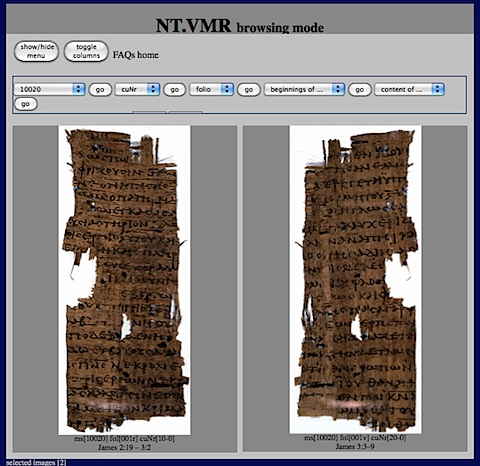
VMR.pngFreunde der neutestamentlichen Wissenschaft und der Textkritik werden von der Internetseite »New Testament: Virtual Manuscript Room« (NT.VMR) begeistert sein.

Das Institut für neutestamentliche Textforschung (INTF) in Münster dokumentiert und erforscht die Geschichte der Überlieferung des Neuen Testaments in seiner griechischen Ursprache. Dafür führt das INTF die so genannte Handschriftenliste, in der sämtliche neutestamentlichen Handschriftenbestände mit ihren Grunddaten katalogisiert sind. Zu jeder neutestamentlichen Handschrift ist im Archiv des INTF eine Akte vorhanden, in der unterschiedlichste Informationen gesammelt sind. Diese Dossiers sollen nach und nach im NT.VMR veröffentlicht werden. Jetzt sind zu folgenden Papyrushandschriften die ersten Dossiers als pdf-Dateien zugänglich: P1, P20, P21, P22, P26 und P37.

Ein Besuch des virtuellen Manuskriptarchivs lohnt sich: intf.uni-muenster.de.

Nach oben scrollen
DSGVO Cookie Consent mit Real Cookie Banner