John David Punch hat unter der Supervision von an G. van der Watt eine Dissertation über die Perikope von der Ehebrecherin (Joh 7,53–8,11) geschrieben. Punch schlägt keine neue Lösung des textkritischen Problems vor (Nestle-Aland stuft den Abschnitt als nicht ursprünglich ein; siehe auch hier), gewährt aber durch seine Arbeit einen Einblick in die aktuelle Diskussion.
A new dissertation in New Testament textual criticism has seen the light at Radboud Universiteit Nijmegen written by John David Punch under the supervision of Jan G. van der Watt, and with the title „The Pericope Adulterae: Theories of Insertion and Omission.“
While the majority of the scholarly world seems to be settled in accepting the fact that the Pericope Adulterae (John 7:53-8:11) is a non- Johannine interpolation, numerous questions remain unanswered in regards to the pericope, such as who penned these words, where the story originates from, and when was it inserted/omitted/re-inserted into the Fourth Gospel. In addition to this, there are mild debates that continue in regards to Greek manuscripts, the influence of lectionary practice, and the relevancy of the Patristic witnesses. Further, there is a minority who still argue for the inclusion of the Pericope Adulterae in the Fourth Gospel. Though there is a majority viewpoint, issues related to John 7:53-8:11 appear to be far from settled.
The present work does not argue for either side, but instead tests a hypothesis of several theories relating to the insertion or omission (and subsequent re-insertion) of the passage from the Gospel of John. Such theories are proposed in relation to collation of internal and external evidence both for and against the inclusion of the pericope. No particular theory is advocated for; instead each theory is evaluated based upon the evidence presented in this work and suggestions for further work are offered.
Chapter 1 presents an introduction to the Pericope Adulterae itself, along with a brief summary of the history of biblical interpretation and the history of such interpretation in relation to the Gospel of John in particular. Five theories of omission/insertion are then highlighted, setting the foundation for the work that will follow. These theories are categorized as Redactional Insertion, Ecclesiastical Insertion, Liturgical Omission, Accidental Omission, and Ecclesiastical Suppression.
Chapter 2 summarizes the history of research regarding John 7:53-8:11, beginning with the nineteenth century developments in textual criticism that broke away from Textus Receptus. This summary is not exhaustive, but rather highlights the major movements in the research of this passage up to the present day, detailing scholars who have either had a profound impact on textual criticism, written major works relating to the Pericope Adulterae, or written multiple works on the subject.
Chapter 3 presents a working translation and exegesis of the pericope. The translation is offered with comparison to the numerous variants associated with the passage; the exegesis is offered based upon the traditional location of John 7:53-8:11 immediately following John 7:52 and preceding 8:12.
Chapters 4 and 5 discuss the internal evidence of the literary context, style, and vocabulary of the Pericope Adulterae. In Chapter 4, comparison is made between the pericope and the immediate context of John 7-8 as well as the larger context of the Gospel of John. This includes discussion of various themes common to the Tabernacles Discourse and to the Gospel of John as a whole. Further, issues of transition between John 7:52 and 8:12 are evaluated. In Chapter 5, suggested “non-Johannine“ and “Johannine“ style and vocabulary are discussed, in addition to arguments relating to hapax legomena, Lukan and/or Synoptic influence, and the relationship between the Pericope Adulterae and Susanna.
Chapter 6 presents the external evidence of the Greek papyri/ manuscripts, manuscripts in additional languages, and the Patristic Witnesses. Evaluation is made in regards to both the presence and absence of John 7:53-8:11 in numerous manuscripts and in the works of various Church Fathers. Further, several theories traditionally offered in response to the external evidence, such as Source Theories, Lectionary Text Theories, Majority Text Theories, and Multiple Edition Theories, are discussed as well.
Chapter 7 discusses each of the theories presented in Chapter 1. The five theories presented include Redactional Insertion, suggesting that a later Johannine redactor or community inserted the pericope at a later date; Ecclesiastical Interpolation, suggesting that later scribes not related to the Johannine redactor or community inserted the pericope; Liturgical Omission, suggesting that due to lectionary practice and manuscripts the pericope was omitted; Accidental Omission, suggesting that multiple copies of the Gospel of John were released, one without the pericope and one with the pericope; and Ecclesiastical Suppression, suggesting that the Church omitted the pericope out of fears that it could be misinterpreted and/or misapplied. Each theory is treated individually, though at times theories overlap with one another. Further, each is evaluated based upon the evidence presented in Chapters 4-6. Following this evaluation, suggestions for further study of the Pericope Adulterae are offered.
 Welche Rolle Johannes der Täufer für den Dienst von Jesus spielte, ist eine gar nicht so einfach zu beantwortende Frage. David Born hat eine packende Arbeit darüber geschrieben: »Die Bedeutung Johannes des Täufers für Jesu Einführung in die Öffentlichkeit und seinen Dienst«.
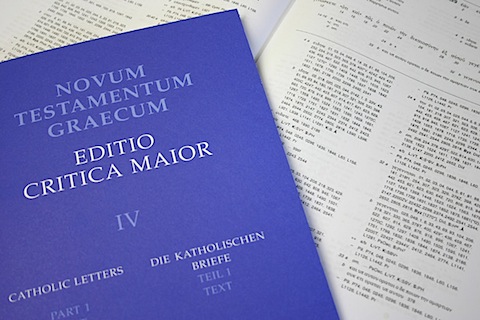 Das Institut für Neutestamentliche Textforschung (INTF) in Münster präsentiert sich im Internet mit einer neuen Plattform. Im Zentrum der Arbeit des Instituts steht die Erforschung der Textgeschichte des Neuen Testaments und die Rekonstruktion seines griechischen Ausgangstextes auf der Basis der gesamten handschriftlichen Überlieferung, der frühen Übersetzungen und patristischen Zitate.
 Kevin de Young hat mit dem hervorragenden Exegeten Andreas Kostenberger über sein Buch