Bibelwissenschaft

Deutsche Bibeln vor Luther

Dass Luther für die große deutschsprachige Bibelübersetzung verantwortlich ist, wissen auch Gelegenheitsleser. Weniger bekannt ist, dass bereits vor Luther mehr als 70 verschiedene Bibelverdeutscher tätig waren und 18 Drucke vollständiger deutscher Bibeln existierten.

Hier mehr: books.google.de.

Zweierlei Diaspora

31rmBvqnF8L._SL160_.jpgUnd wieder eine neue Perspektive:

Ein schmales Büchlein mit einer These, die unser Bild des antiken Judentums grundlegend verändert. Denn innerhalb der jüdischen Geschichtsschreibung hatte man bisher weithin angenommen, dass sich in der Antike das religiöse und kulturelle Leben im östlichen wie im westlichen Judentum unter dem Einfluss der Rabbinen des Landes Israel, der Tannaim (1. und 2. Jahrhundert nach Christus) und der Amoraim (etwa 220 bis 360/70), entwickelt habe.

Demgegenüber behaupten der Althistoriker Doron Mendels von der Hebräischen Universität in Jerusalem und der in Tel Aviv lehrende Rechtshistoriker Arye Edrei jetzt, die jüdische Diaspora, also die Welt der Juden, die außerhalb Palästinas lebten, sei in dieser Zeit zweigeteilt gewesen: Es habe zwei Sprachen, Griechisch (und in geringerem Maße auch Lateinisch) im Westen und Hebräisch/Aramäisch im Osten, gegeben und, damit eng verknüpft, auch zwei »Wissenskulturen«, ja »zweierlei Judentum«.

Ich gestehe, ich habe das Buch bisher nicht gelesen (und bin zurückhaltend). Allerdings vermute ich, dass sich die These, das europäische Judentum sei in der ausgehenden Antike eine bunte Ansammlung von Gruppen mit unterschiedlicher Homogenitäts- und Organisationsdichte gewesen, recht gut belegen lässt.

Hier die Rezension von Wolfram Kinzig: www.faz.net. Das Buch:

  • Doron Mendels und Arye Edrei: »Zweierlei Diaspora«: Zur Spaltung der antiken jüdischen Welt, Vandenhoeck & Ruprecht, Göttingen 2010. 159 S., 24,90 Euro

gibt es auch:

BestCommentaries.com

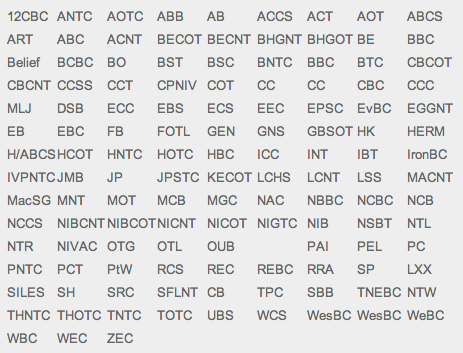
»Kennst Du einen guten Kommentar zu …?« ist eine Frage, die ich immer wieder zu hören bekomme. Die Zahl der empfehlenswerten Kommentare in deutscher Sprache ist überschaubar (und manchmal sind sie so teuer, dass ich gleich auf eine Bibliothek verweise). Im angelsächsischen Sprachraum werden dagegen so viele Werke und Reihen angeboten, dass der Bibelleser schnell den Überblick verlieren kann.

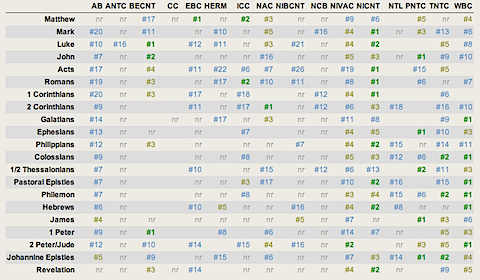
John Dyer hat www.BestCommentaries.com entwickelt. Die sehr übersichtlich gestaltete Internetseite kann auf der Suche nach guten Angeboten im Kommentardschungel hilfreich sein.

Hier ein Blick auf den tabellarischen Vergleich:

Bildschirmfoto 2010-07-08 um 15.45.20.png

VD: HB

Gottes Fußsohle im Jordan-Tal?

40 Jahre lang soll die Wanderschaft der Juden gedauert haben, als sie nach der Sklaverei in Ägypten ins Heilige Land Israel gelangten und sich dort im Jordan-Tal niederließen. Ist diese biblische Geschichte wirklich wahr oder ein Mythos? Der Archäologe Adam Zertal will darauf nun eine Antwort gefunden haben.

Richard C. Schneider berichtet aus dem ARD-Studio Tel Aviv über den Professor von der Universität Haifa: www.tagesschau.de.

VD: J

Die Entfremdung von der Bibel

Das schrieb Gerhard Ebeling vor 30 Jahren:

Der Bibelgebrauch ist weithin auf den kirchlich institutionalisierten Umgang mit ihr reduziert. Ihre Rolle als Hausbuch und als privates Andachtsmittel ist stark geschrumpft. Die Zahl derer, die keine oder nur eine ganz verzerrte Vorstellung von ihr haben, ist weiter im Wachsen. Die Bibelkenntnis ist bis in kirchentreue Kreise hinein, sogar bei Theologiestudenten, erschreckend gering. Und selbst bei gutem Willen fühlt man sich dem Dickicht dieses Buches gegenüber hilflos. Auch unter politisch denkbar freiheitlichen Verhältnissen, die den Kirchen sogar noch gewisse Privilegien wie den schulischen Religionsunterricht einräumen, ist diese Entfremdungstendenz anscheinend kaum aufzuhalten. Sie wird vom Sog des Zivilisationsgefälles und seiner vorherrschenden kulturellen Erscheinungen vorangetrieben und zum Teil noch gefördert durch fragwürdige religionsdidaktische Theorien oder auch einfach durch einen desolaten Zustand pädagogischer Praxis.

Was für Worte würde er heute finden?

Interview mit Andreas Kostenberger

51pZEBljdrL._SL160_.jpgKevin de Young hat mit dem hervorragenden Exegeten Andreas Kostenberger über sein Buch The Missions of Jesus and the Disciples According to the Fourth Gospel gesprochen.

Kevin: In a couple sentences, what is the mission of Jesus in the gospel of John? Is the mission of the disciples the same as Jesus’ mission?

Kostenberger: Essentially, there are three facets to Jesus’ mission in John’s Gospel: he is (1) the sent Son; (2) the one came into the world and returned to the place from where he came (descent-ascent); and (3) the eschatological Shepherd-teacher. The mission of the disciples is similar to Jesus’ only with regard to his sending, that is, they are to emulate the obedient and faithful relationship Jesus sustained with the Father in their relationship with the exalted Jesus as they go about their mission.

Hier mehr: thegospelcoalition.org.

Neue Dissertation über »Jesus und die Ehebrecherin«

John David Punch hat unter der Supervision von an G. van der Watt eine Dissertation über die Perikope von der Ehebrecherin (Joh 7,53–8,11) geschrieben. Punch schlägt keine neue Lösung des textkritischen Problems vor (Nestle-Aland stuft den Abschnitt als nicht ursprünglich ein; siehe auch hier), gewährt aber durch seine Arbeit einen Einblick in die aktuelle Diskussion.

Hier das Abstract:

A new dissertation in New Testament textual criticism has seen the light at Radboud Universiteit Nijmegen written by John David Punch under the supervision of Jan G. van der Watt, and with the title „The Pericope Adulterae: Theories of Insertion and Omission.“

While the majority of the scholarly world seems to be settled in accepting the fact that the Pericope Adulterae (John 7:53-8:11) is a non- Johannine interpolation, numerous questions remain unanswered in regards to the pericope, such as who penned these words, where the story originates from, and when was it inserted/omitted/re-inserted into the Fourth Gospel. In addition to this, there are mild debates that continue in regards to Greek manuscripts, the influence of lectionary practice, and the relevancy of the Patristic witnesses. Further, there is a minority who still argue for the inclusion of the Pericope Adulterae in the Fourth Gospel. Though there is a majority viewpoint, issues related to John 7:53-8:11 appear to be far from settled.

The present work does not argue for either side, but instead tests a hypothesis of several theories relating to the insertion or omission (and subsequent re-insertion) of the passage from the Gospel of John. Such theories are proposed in relation to collation of internal and external evidence both for and against the inclusion of the pericope. No particular theory is advocated for; instead each theory is evaluated based upon the evidence presented in this work and suggestions for further work are offered.

Chapter 1 presents an introduction to the Pericope Adulterae itself, along with a brief summary of the history of biblical interpretation and the history of such interpretation in relation to the Gospel of John in particular. Five theories of omission/insertion are then highlighted, setting the foundation for the work that will follow. These theories are categorized as Redactional Insertion, Ecclesiastical Insertion, Liturgical Omission, Accidental Omission, and Ecclesiastical Suppression.

Chapter 2 summarizes the history of research regarding John 7:53-8:11, beginning with the nineteenth century developments in textual criticism that broke away from Textus Receptus. This summary is not exhaustive, but rather highlights the major movements in the research of this passage up to the present day, detailing scholars who have either had a profound impact on textual criticism, written major works relating to the Pericope Adulterae, or written multiple works on the subject.

Chapter 3 presents a working translation and exegesis of the pericope. The translation is offered with comparison to the numerous variants associated with the passage; the exegesis is offered based upon the traditional location of John 7:53-8:11 immediately following John 7:52 and preceding 8:12.

Chapters 4 and 5 discuss the internal evidence of the literary context, style, and vocabulary of the Pericope Adulterae. In Chapter 4, comparison is made between the pericope and the immediate context of John 7-8 as well as the larger context of the Gospel of John. This includes discussion of various themes common to the Tabernacles Discourse and to the Gospel of John as a whole. Further, issues of transition between John 7:52 and 8:12 are evaluated. In Chapter 5, suggested “non-Johannine“ and “Johannine“ style and vocabulary are discussed, in addition to arguments relating to hapax legomena, Lukan and/or Synoptic influence, and the relationship between the Pericope Adulterae and Susanna.

Chapter 6 presents the external evidence of the Greek papyri/ manuscripts, manuscripts in additional languages, and the Patristic Witnesses. Evaluation is made in regards to both the presence and absence of John 7:53-8:11 in numerous manuscripts and in the works of various Church Fathers. Further, several theories traditionally offered in response to the external evidence, such as Source Theories, Lectionary Text Theories, Majority Text Theories, and Multiple Edition Theories, are discussed as well.

Chapter 7 discusses each of the theories presented in Chapter 1. The five theories presented include Redactional Insertion, suggesting that a later Johannine redactor or community inserted the pericope at a later date; Ecclesiastical Interpolation, suggesting that later scribes not related to the Johannine redactor or community inserted the pericope; Liturgical Omission, suggesting that due to lectionary practice and manuscripts the pericope was omitted; Accidental Omission, suggesting that multiple copies of the Gospel of John were released, one without the pericope and one with the pericope; and Ecclesiastical Suppression, suggesting that the Church omitted the pericope out of fears that it could be misinterpreted and/or misapplied. Each theory is treated individually, though at times theories overlap with one another. Further, each is evaluated based upon the evidence presented in Chapters 4-6. Following this evaluation, suggestions for further study of the Pericope Adulterae are offered.

Die Arbeit kann hier herunter geladen werden: FORMATTED.%20JD%20PUNCH%20FINAL%203.4.10a.pdf.

VD: evangelicaltextualcriticism.blogspot.com

Ein theologischer Dialog mit N.T. Wright

conf-banner-1a.jpg

William Evans (Erskine College, U.S.A.) hat die »Wheaton Conference« zu Ehren von N.T. Wright besucht und einen ausgezeichneten Rückblick verfasst.

I had fears that the conference would be an exercise in hagiography, but that concern was quickly dispelled when the first conference speaker, Richard Hays of Duke University, came out swinging. Still miffed over a critique by Wright at the 2008 SBL meeting of a book that Hays had edited, the Duke Neuestestamentler contended that Wright’s historical treatment of the Gospels, with its emphasis upon historical proof, still operates out of an essentially modernist/historicist mindset, and he complained that the individual voices of the Evangelists seem to disappear into Wright’s synthesis of the Synoptic Gospel accounts. Hays also asked the probing question of how the picture of Jesus which emerges from Wright’s historical reconstruction relates to the church’s confessional tradition, before concluding with a call for a rapprochement between Wright and Karl Barth.

Hier der vollständige Report von Professor Evans: www.reformation21.org. Die Vorträge gibt es als Audio- oder Videomitschnitte: www.wheaton.edu.

Ich konnte bisher nur den Vortrag von Markus Bockmuehl aufmerksam hören. Der von mir sehr geschätzte Experte für das »Judentum zur Zeit Jesu« setzt sich mit der Frage auseinander, ob der Apostel Paulus nach seinem Tod in den Himmel aufgenommen wurde. Diese Fragestellung mag für einige Christen merkwürdig klingen. Hintergrund ist die Behauptung von N.T. Wright, dass die eschatologische Bestimmung des Menschen gerade nicht der Himmel, sondern die Erde sei. Bockmuehl weist nach, dass N.T. Wright sich mit seiner These nicht nur von den Eschatologien des Judentums und der Kirchenväter absetzt, sondern auch die Eschatologie des Neuen Testamentes insgesamt nicht ernst genug nimmt. Wright liegt richtig, wenn er betont, dass die Auferstehung der Christen leiblich sein wird so wie die Auferstehung von Jesus Christus es war. N.T. Wright liegt auch richtig, wenn er hervorhebt, dass der Dualismus von der Welt oben und der Welt unten bei der Erfüllung aller Dingen überwunden wird. Aber zu behaupten, der Himmel sei nicht Bestimmungsort der Glaubenden, verkürzt den paulinischen Befund. Bockmuehl: »Nach dem Neuen Testament ging Paulus in den Himmel, als er starb.«

Hier der hervorragende Vortrag als mp3-Datei: 100417Bockmuehl.mp3.

Nach oben scrollen
DSGVO Cookie Consent mit Real Cookie Banner